- There is no single undisputed original viol with a original spruce soundboard from the 16th-century, that could serve as the basis for a faithful copy.
- Scientific studies assume that the soundpost only emerged in the second half of the 16th century. The use of the vertical bass bar (parallel to the wood grain) is closely related to the use of the soundpost.
The earliest evidence of a soundpost is found on two bowed string instruments from Freiberg Cathedral - built before 1594 - that remain in a nearly original state. In these instances, however, the soundpost is positioned beneath the center seam of the belly, and there is no bass bar. It was not until 1636 that Mersenne, in his *Harmonie universelle*, mentioned an *âme* (soundpost) located beneath the treble foot of the bridge.
- Around 1500, lutes / vihuelas with their flat soundbords enjoyed a very high reputation in aristocratic society and were highly valued. They were status symbols and their traditional static construction featured cross bars (cross to the wood grain) on the underside of the soundboard.
- Historical illustrations of early viols clearly show flat soundboards - comparable to those of lutes or vihuelas. Carved, arched soundboards only appear in later illustrations.
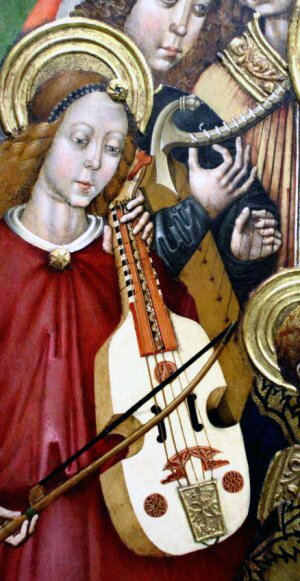
One of the oldest depictions of a viola da gamba (c. 1475–85) from Valencia, showing a straight bridge foot on the soundboard.
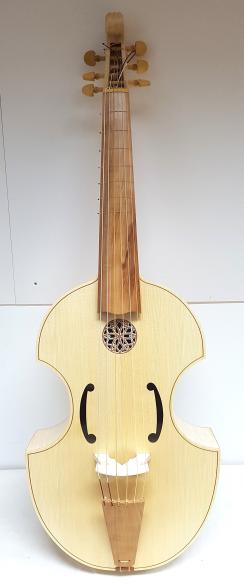
All of these facts together formed the basis for my design of a Renaissance viola da gamba around 1500 with bars crosswise to the wood grain on the soundboard and without a soundpost.
The stringing was of course completely in gut!
The origins of the viola da gamba trace back to the culturally diverse Spain of the 15th century- specifically, the Kingdom of Aragon. Its playing position and technique derive from the *rabab*, a Moorish bowed instrument still played in North Africa today. Its body shape, stringing, and frets originate from the *vihuela de mano*, a historical plucked instrument with a flat soundboard and a flat back that played a prominent role in Spain and parts of Italy during the 15th and 16th centuries.
Between 1470 and 1500, the new instrument - the viola da gamba frequently appeared in Aragonese paintings from the Valencia region.
Thanks to its "delightfully sweet" sound, the viol spread from Valencia across all of Europe around 1500.
The oldest known depiction dates from around 1470. It can be assumed that viols already existed somewhat before (from 1450). This means that, during their approximately 300-year period of use, viols were built without a soundpost for about 100 years.
A soundboard construction without a soundpost produces an bowed Instruments a significantly different sound than one with a soundpost.
During the Renaissance and early Baroque periods, the bass viola da gamba was valued as a foundational instrument in ensembles (consorts) or for accompaniment. In solo literature, however, polyphonic playing in the tenor and middle registers predominated. The low bass range did not assume a pivotal role in solo music for the viola da gamba until the second half of the 17th century - in the baroque.
The "sweet" sound resulting from the crosswise baring construction harmonizes perfectly with Renaissance lutes, vihuelas, and other instruments of that era. In contrast to Baroque viola da gambas, which - due to their construction featuring a carved, arched belly with a vertical bass bar and soundpost - produce a sound that is too voluminous and bass-heavy when played alongside Renaissance instruments.
However, due to the static construction with crosswise bars, the acoustic performance at low frequencies is unsatisfactory.
In the case of bow instruments featuring a crosswise bars, I see no structural solution that would facilitate the desired shift in tonal conception toward a functional, expanded bass register and a more voluminous sound. Consequently, a new design had to be developed. We are not familiar with the precise, non-linear transformation process - away from the crosswise-bar soundboard. I view the viola da gamba without soundpost with carved-arched soundboard of relatively great thickness - built according to the specifications in Silvestro Ganassi’s *Regola Rubertina* (Venice, 1542–43) as part of the Schola Cantorum Basiliensis research project (2011–13) - as an intermediate step. According to the report, the problem at the low frequencies has not yet been solved with this design. This development ultimately led to the structurally advantageous design familiar to us today: featuring a carved, arched soundboard and back (carved from a glued thick block of spruce wood), a vertical bass bar running parallel to the grain (for a more resonant bass), and a movable soundpost positioned in the treble area beneath the bridge to ensure stability. Additionally, this enabled a coupling of the top and back. The great advantage of this design, with its movable soundpost, lies in the ability to make subsequent tonal adjustments. Thus, the design of the bowed instruments, the violin family, as we know it today, was born.
In my opinion, it is no coincidence that the arched, carved soundboard of stringed instruments - in combination with the soundpost and the bass bar - originated during precisely that period, when the bass registers of the lute were also gradually expanded: from six courses in 1574 to seven, then to eight or nine around 1600, to ten from 1611 onwards, and finally to as many as thirteen, including the invention of the basso continuo lute.
Following this development process, around 1600 a musical paradigm shift took place: the transition from the Renaissance style of polyphony - characterized by voices of equal importance - towards the basso continuo in combination with a prominent upper voice, a characteristic of the Baroque period. Only the preceding, gradual further development in the construction of bowed stringed instruments (especially the construction of the soundpost and bass bar) to achieve a deeper timbre and a functional bass register enabled the satisfactory use of the viola da gamba in the basso continuo and solo music in the Baroque period.
During the transformation from Renaissance viol ttothe Baroque viol, the flat back with its crosswise bars was retained. Only the soundboard was altered to suit the new construction.
Finally, it is worth noting that when examining the development processes of string instruments, one must not overlook technological advances in the production of gut strings (where known) as a contributing factor.
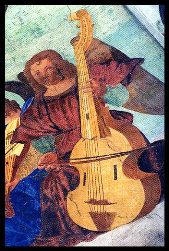
The following historical illustration has served as a template:
The Coronation of the Virgin, Ferrara, Italy, fresco c. 1510–15, detail from the "Concert of Angels," convent church: Chiesa Santa Maria della Consolazione.
Attributed to Michele Coltellini or Baldassarre Carrari.